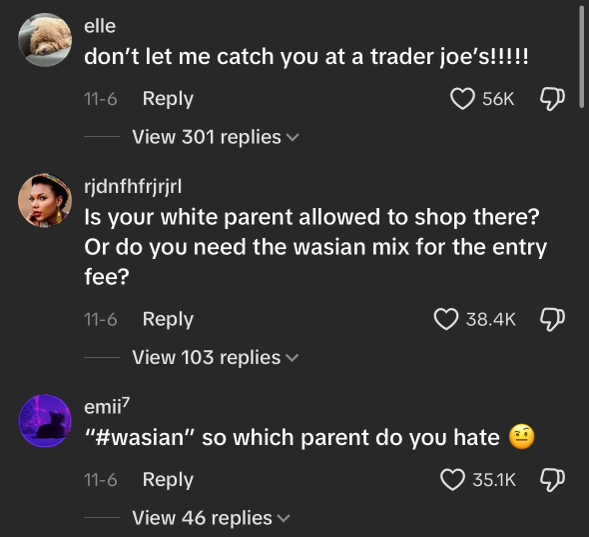
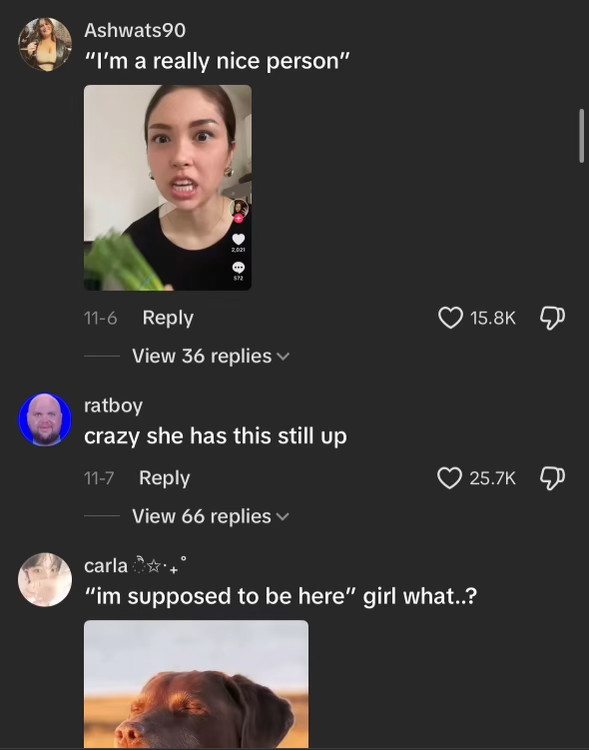
In September 2025, TikTok user Madeline Qi posted a satirical video commenting on her relationship with her own identity as well as her perception of whiteness. The video has sparked a string of debates online across multiple communities. Initially, Madeline received backlash for her video, both in her comment section and from other creators on the app. Large Asian American content creators, such as Soogia and TheKoreanVegan, responded to Madeline’s video, criticizing her for being exclusionary against white patrons. These videos catapulted the situation’s exposure, and hundreds of non-Asian TikTok users flocked to Madeline’s account to criticize and attack her. Eventually, she was doxxed because of the video, an internet phenomenon wherein users post personal information about an individual to worsen the severity of their harassment. Even after months of this behavior, Madeline continued to keep the video posted on her page. As time passed and the videos criticizing her circulated, smaller content creators came to her defense, including other Asian American women.
The most poignant detail when I look at this story is the input of larger creators. One creator with over six hundred thousand followers even went as far as to say, “Every time I go to the Korean grocery store and I see non-Korean people that look like a fish out of water… I go up and I ask them if they need help.” This statement comes across as dubious, and many were quick to dispute it. Despite being over a century since cases like Pong Dock and the Lum family, we still see a trend of Asian Americans pandering to white people and seeking acceptance in white society. It shares a similar mentality, potentially subconsciously, to that of Gong Lum when he advocated for his family. Instead of seeking solidarity within our own community, it has historically been a response to position ourselves as close to white society as possible as a means of self-preservation.
This dynamic resurfaces generation after generation, often in moments of public scrutiny when Asian Americans feel compelled to prove they are “reasonable,” “nonthreatening,” or “fair” arbiters of racial discourse. In the digital age, platforms like TikTok accelerate these pressures, as creators with large followings often become de facto representatives of entire communities—roles they may not be prepared for, yet ones they perform in ways that continue to reinforce racial hierarchies. Not even five years prior, Asian Americans were facing some of the most intense racial discrimination in this country they have seen in decades due to the Coronavirus. It may be easy to believe that racism is a structure of the past, but it is still very much ingrained in our upbringing and socialization.
The irony, of course, is that Madeline’s video was itself a commentary on identity, belonging, and the absurdity of these expectations. Yet the public reaction illuminated how little space there is for Asian Americans—especially women—to articulate frustration with racialized experiences without facing accusations of hostility. It is now more important than ever that we recognize how our ancestors’ experiences shape the world we have inherited. From analyzing history, we can see that it is not enough to simply survive an oppressive system, but we must work actively to combat it and how it has shaped our minds.